
🏛️ Decoding C-Level Priorities: What Really Drives IT Transformation Decisions
A practical guide to understanding how executives think about technology investments. 📈✨
After the collective analysis of data from over 12,000 CIOs, interviewing dozens of C-suite executives, and studying billions in IT investments, I’ve come to realize something crucial: most technology initiatives fail not because of bad technology, but because they don’t align with what executives actually care about. 📉❌
Let me share a framework—the Foundation Pyramid—that represents how C-level executives think about technology investments. It’s not theoretical; it’s based on real budgets and business outcomes from Fortune 500 companies. 👇
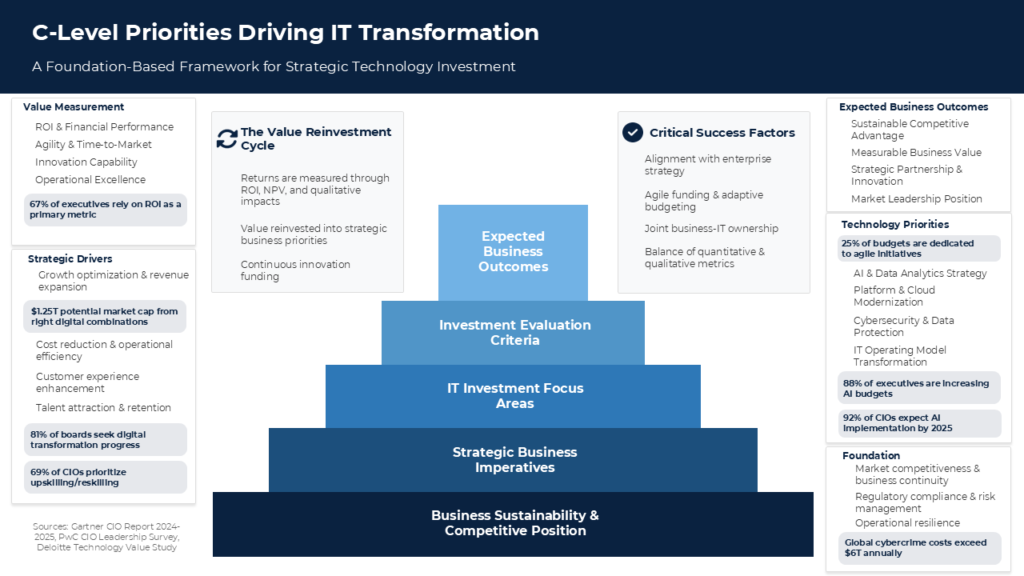
🧱 Layer 1: The Foundation – Business Sustainability & Competitive Position
Before any CIO talks about cloud migration, the CEO is asking: “Will our company survive and thrive?” 🛡️
- The Cost of Inaction: Cybercrime now costs corporations over $6 trillion annually. 💸
- The Agility Gap: Companies failing to modernize lose market share to “hungry” competitors.
- Risk Management: Regulatory failures result in massive fines and irreparable brand damage.
Executive Insight: If your proposal doesn’t address business sustainability or competitive positioning, you’ll struggle to get attention. This foundation is non-negotiable.
🚀 Layer 2: Strategic Business Imperatives
Once survival is secured, executives shift to growth and optimization through four key pillars:
- Growth Optimization & Revenue Expansion: 81% of boards report they haven’t made adequate progress toward digital goals. Executives want tech that enables new revenue streams or accelerates sales cycles. 💰
- Cost Reduction & Operational Efficiency: CFOs seek transformation-level improvements (30% to 70% reductions), not just minor 5% gains. The right digital actions can unlock $1.25 trillion in market cap. ⚙️
- Customer Experience (CX) Enhancement: Customers trained by Amazon and Netflix expect seamless experiences. If you don’t deliver, they’ll find someone who does. 😊
- Talent Attraction & Retention: 69% of CIOs prioritize upskilling in 2024. The best talent wants to work with modern stacks, not legacy systems. 🎓
💡 Layer 3: IT Investment Focus Areas
This is the “what” of IT transformation. If your proposals don’t fit into one of these buckets, you’ll need a compelling reason why:
- AI & Data Analytics Strategy: 92% of CIOs believe AI will be implemented by 2025, but 49% struggle to demonstrate its value. You must articulate concrete, measurable outcomes. 🤖
- Platform & Cloud Modernization: Legacy systems are the silent killers of agility. Modernization is no longer optional; it’s a survival requirement. ☁️
- Cybersecurity & Data Protection: This has evolved from an IT issue to a board-level risk that can destroy shareholder value overnight. 🔒
- IT Operating Model Transformation: Replacing waterfall projects and centralized control with agile funding and product-based teams. 🏃♂️
📊 Layer 4: Value Measurement – How Success is Evaluated
Many initiatives fall apart due to poor value articulation. The metrics that matter include:
- ROI & Financial Performance: (Used by 67% of leaders). However, as Eli Lilly CIO Diogo Rau notes, value is also found in innovation, not just spend. 💵
- Agility & Time-to-Market: Can tech help you launch products or respond to market changes faster? ⏱️
- Operational Excellence: Cycle time reduction, error rates, and automation levels tell the story of day-to-day improvement. ✅
🏆 The Peak: Expected Business Outcomes
At the top of the pyramid sit the outcomes every executive dreams about:
- Sustainable Competitive Advantage: Building capabilities that are hard to replicate.
- Measurable Business Value: Value you can quantify and celebrate in the boardroom. 🥂
- Strategic Partnership & Innovation: Transforming vendor relationships into co-creation. 🤝
- Market Leadership Position: Becoming known as an industry leader for how you innovate.
🔄 The Value Reinvestment Cycle
Great IT organizations don’t just create value; they reinvest it. They measure returns, quantify value (cost savings/revenue), and reinvest a portion back into strategic priorities to fund continuous innovation. 🔁
✅ Critical Success Factors
- Alignment with Enterprise Strategy: As Ally Financial CIO Sathish Muthukrishnan says, make the tech strategy a joint strategy for the company. 🎯
- Agile Funding: Dedicating budgets to agile initiatives and moving from annual cycles to value-driven reviews.
- Joint Business-IT Ownership: Blurring the lines between functions to ensure shared accountability. 🤝
🏁 Final Thoughts: From Transaction to Transformation
Remember: Executives don’t buy technology—they buy business outcomes. 🌍✨
- Start at the foundation (Sustainability).
- Connect to Strategic Imperatives (Growth/Efficiency).
- Define success metrics upfront.
- Think in cycles, not just projects.
When you master the art of connecting technology investments to the outcomes executives care about, you stop being a cost center and start being a strategic partner.
About the Research: This article is based on data from Gartner’s CIO Report (12,000+ CIOs), PwC’s CIO Leadership Survey, Deloitte’s Technology Value Study, and direct interviews with C-level technology executives across multiple industries.
