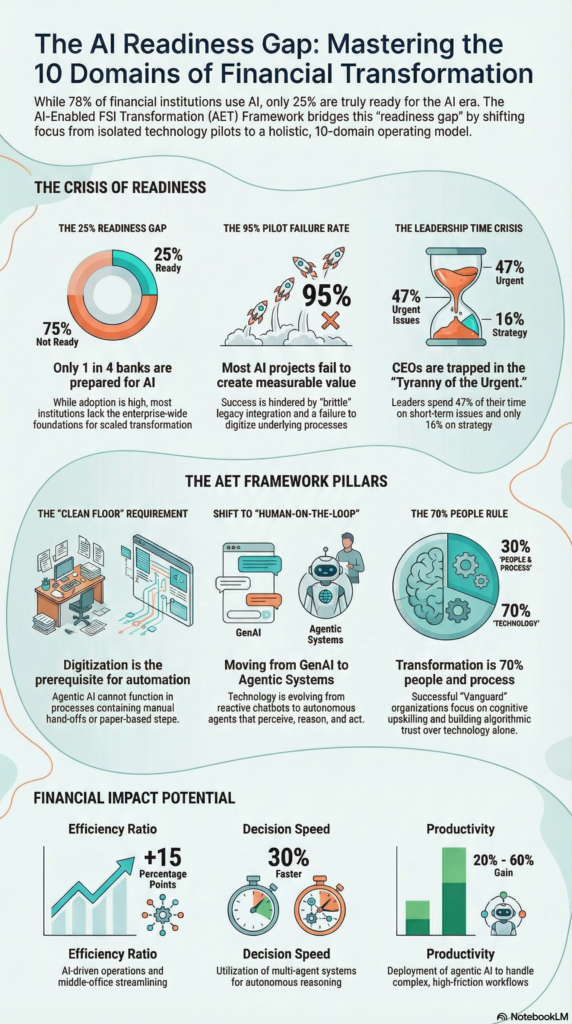
🤖 The AI-Enabled FSI Transformation (AET) Framework: Moving Beyond Digitization
The strategic evolution from “Digital” to “Intelligent” execution. 🚀🏦
Digital transformation helped financial institutions modernize channels and streamline operations. But AI is changing the game. What worked for digitization alone is no longer enough. We now live in a world shaped by intelligent automation, agentic systems, and predictive decisioning. Financial services institutions (FSIs) need a broader model—one that treats AI as a core operating capability rather than a side initiative.
The AI-Enabled FSI Transformation (AET) Framework is the practical evolution designed to move organizations from the “88%” wasting billions on AI hype into the 12% “Vanguard” achieving real revenue growth and cost reduction. 👇
⚠️ Why This Matters Now: The Scale Gap
Many institutions are stuck in “pilot purgatory”, isolated labs and departmental tools disconnected from enterprise strategy. The future belongs to those who redesign their entire operating model around AI-enabled execution.
🏛️ The 10 Dimensions of the AET Framework
1. Leadership: Strategic Orchestration 🔭
Leadership must move from sponsorship to orchestration. Leaders align strategy, governance, and investment to ensure AI is tied to business outcomes, closing the “learning gap” that stalls most projects.
2. Architecture: Composable & AI-Ready 🧩
Rigid legacy environments are scale-killers. A composable architecture allows for modular integration, connecting data across functions and embedding models directly into core business processes.
3. Culture: Algorithmic Trust 🤝
Culture is now about trust. Employees must see AI as a co-pilot, not a threat. Success requires building “algorithmic trust” through transparency, workflow redesign, and clear human accountability.
4. Customer: Predictive Anticipation 🔮
Experience moves from personalization to anticipation. AI allows FSIs to infer needs and support customers proactively—helping them before they even think to ask.
5. Data: Learning Feedback Loop 📊
Data is the learning engine. AI systems require real-time, high-quality, governed data pipelines that support continuous model improvement through a constant feedback loop.
6. Digitization: Process Foundation 🧱
AI cannot scale on top of broken or paper-based processes. Full digitization creates the “clean floor” that intelligent systems and AI agents need to execute effectively.
7. Financial: Cognitive ROI 💰
We must rethink value. Traditional metrics miss the point. Cognitive ROI includes capacity creation, cycle-time compression, and the operating leverage created by autonomous workflows.
8. Organization: Agile AI Cells 👥
Traditional hierarchies are too slow. Organizations need Agile AI Cells—distributed authority for experimentation paired with centralized accountability for security and ethics.
9. Technology: Agentic Systems 🤖⚙️
The next wave is agentic: systems that reason, act, and navigate multi-step workflows with minimal intervention. This opens new frontiers in compliance, fraud, and internal productivity.
10. Workforce: Human-in-the-Loop 🎓
The most effective transformation doesn’t remove people; it elevates them. The workforce of the future focuses on prompt design, AI oversight, and high-level judgment. Human accountability remains essential.
🏁 The Real Takeaway
The AET Framework isn’t about adding AI to the edge of the business. It’s about asking: “How do we transform the enterprise so AI can create durable value at scale?” 🌍✨
For financial services leaders, the opportunity is significant, but the window is narrowing. The shift from “Digital” to “AI-Enabled” is no longer a choice; it is the requirement for the next era of banking.