The 14% Problem: Why Your Workforce Isn’t Using AI (And How to Fix It) 🧠
Financial services institutions are pouring billions into Artificial Intelligence, yet we are facing a stark reality: only 14% of workers use Generative AI daily.
Why is there such a massive gap between deployment and actual adoption? The hurdle isn’t technological capability or digital literacy; it is fundamentally a cultural issue. While 73% of consumers worldwide trust content created by generative AI, our internal workforces remain hesitant.
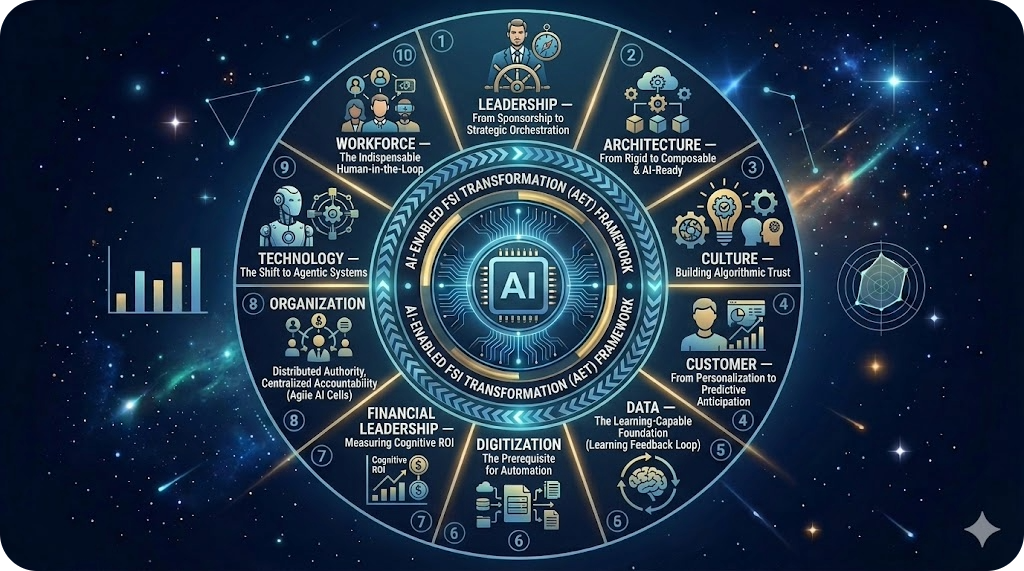
To unlock real value, we must look to Domain 3 of the AI-Enabled FSI Transformation (AET) Framework: Culture.
🤝 The Shift: From Change Tolerance to Algorithmic Trust Traditional change management is no longer sufficient. Organizations must evolve from merely tolerating change to actively building “algorithmic trust”. This means moving past the fear of human replacement and intentionally cultivating a “co-pilot” culture where humans and AI collaborate seamlessly.
Academic research, such as the 2026 study by Dang & Li, confirms this approach, noting that trust in AI is deeply shaped by institutional trust, transparency, and cultural context. In fact, high-performing AET organizations are 3x more likely to redesign their entire workflows around human-AI teaming, rather than simply giving employees access to AI tools and hoping for the best.
🏢 How Industry Leaders are Building Algorithmic Trust Leading financial institutions are already proving that when you prioritize culture, adoption follows:
- Morgan Stanley’s 98% Solution: While the industry average for daily AI use sits at 14%, Morgan Stanley has achieved a staggering 98% adoption rate among its Wealth Management Advisors. They accomplished this by shifting the culture from skepticism to adoption through highly practical, productivity-boosting use cases.
- DBS Bank’s Ethical Foundation: To alleviate cultural resistance, DBS Bank created the internal P-U-R-E framework as they scaled AI. By ensuring AI initiatives are Purpose-driven, Unbiased, Responsible, and Explainable, they gave their workforce clear ethical guardrails to confidently use AI.
- Wells Fargo’s Mutual Responsibility: Recognizing that AI adoption requires an educational foundation, Wells Fargo is driving a massive AI literacy push. As Saul Van Beurden (Head of AI) pointed out, employees and employers share a “mutual responsibility” to reskill for the age of AI.
💡 The Takeaway Technology alone will not drive transformation. If you want to achieve better outcomes and adhere to the AET Framework, you must actively architect a culture of algorithmic trust. Your workforce needs to know that AI is not a replacement strategy, but an empowerment strategy.