🏗️ Why 95% of AI Pilots Fail: The Architecture Problem 🏗️
The financial services sector is rushing toward an AI-driven future, yet there is a staggering roadblock: 95% of AI pilots in financial services stall and fail to create measurable value. Why does this happen? The answer rarely lies in the AI models themselves. The primary culprit is brittle integration caused by decades-old legacy systems. Without the right infrastructure, advanced AI capabilities remain “trapped in silos” rather than being seamlessly embedded into the core banking fabric.
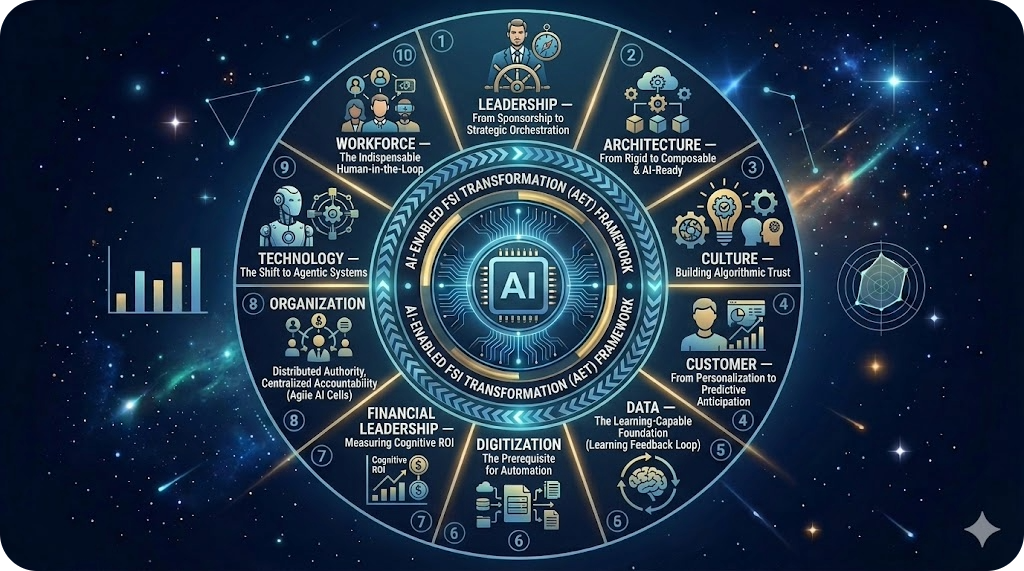
This brings us to a critical pillar of the AI-Enabled FSI Transformation (AET) Framework—> Domain 2: Architecture.
To achieve true enterprise-scale deployment, financial institutions must evolve from rigid, monolithic systems to composable, AI-ready infrastructures that enable true “plug-and-play” AI capabilities.
🔄 The Rise of BIAN and Composable Systems The Banking Industry Architecture Network (BIAN) has emerged as the critical framework for this transition. Between 2023 and 2024, BIAN reached a pivotal turning point, becoming the recognized standard for banks transitioning their operations to the Cloud. It provides pre-defined, standardized components that allow banking capabilities (like Payments or Lending) to be delivered as dynamically combinable services.
This modular approach is the future. As Gartner highlighted in its recent predictions, “composable modularity remains a growing architecture pattern” that fundamentally changes how infrastructure is structured to support data-centric AI.
🏢 Real-World Execution: HSBC & JPMorgan Chase Industry leaders aren’t just talking about composable architecture; they are making massive strategic bets on it:
- HSBC’s $1.8B Bet: HSBC is actively retiring one-third of its legacy applications over the next two years. Backed by a $1.8 billion investment, this AI-powered reengineering initiative eliminates integration bottlenecks and migrates the bank to cloud-native, modular services.
- JPMorgan Chase’s Agentic Leap: By moving past rigid workflows, JPMorgan Chase is utilizing orchestrated multi-agent systems to handle complex decision-making. Institutions leveraging these architectures are seeing incredible results, including credit analyst productivity gains of 20-60% and 30% faster decision-making.
⚡ Looking Ahead: LLMOps and Real-Time Data An AI-ready architecture isn’t just about breaking down monoliths; it must also actively support Large Language Model Operations (LLMOps) and real-time data streaming. For agentic AI systems to make autonomous, accurate decisions, they require an underlying data fabric that provides intelligent, unified access to distributed data across the enterprise in real-time.
The Bottom Line: The architectural domain is foundational—it actively enables or constrains every other aspect of your AI transformation. You cannot build the bank of the future on the infrastructure of the past.