🤖 RIP the Basic Chatbot: Why Banking is Moving from “Prompting” to “Agentic” Autonomy 🤖
Let’s be brutally honest: we have all found ourselves aggressively typing “SPEAK TO A HUMAN” into a bank’s digital customer service window. For years, the banking industry’s idea of cutting-edge technology was a chatbot that acted like a digital toddler, only able to respond to highly specific prompts, and frequently failing at that.
Thankfully, that era is coming to an end.
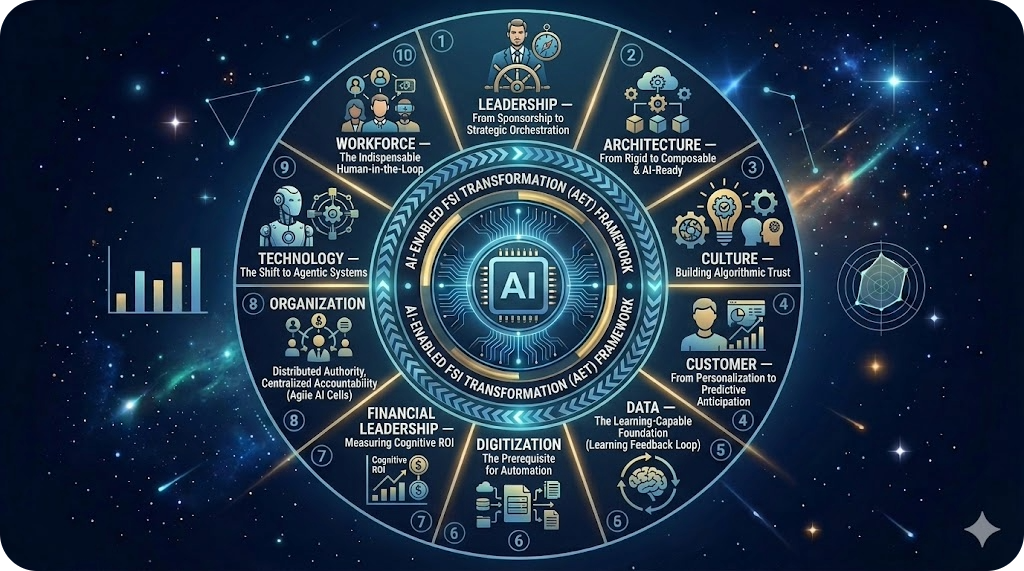
Welcome to Domain 9 of the AI-Enabled FSI Transformation (AET) Framework: Technology — The Shift to Agentic Systems. If you want to achieve better outcomes in financial services, it is time to stop playing 20 Questions with generative AI and start deploying autonomous agents.
🧠 The Evolution: From “Prompt-Takers” to “Action-Makers” Under the AET framework, the focus shifts entirely away from standalone chatbots and toward Autonomous Agents that can actually navigate internal systems, handle fraud exceptions, and perform complex compliance reporting with minimal human intervention.
Here is the difference: today’s Generative AI waits patiently for your prompt before doing anything, whereas Agentic AI can independently perceive, reason, act, and learn without constant human guidance. It essentially works more like a human colleague, handling tasks independently, collaborating with other systems, reflecting on its progress, and actually improving through repetition.
Technically speaking, these agents possess three superpowers:
- Perception: They sense and interpret environmental conditions.
- Reasoning: They use logic to evaluate options and make decisions.
- Action: They actually execute decisions via API calls and tool use. (Yes, they actually do the work instead of just writing a poem about it).
📈 The “Human-ON-the-Loop” Revolution This technology requires a massive operational shift from “human-in-the-loop” (where a human directly controls the process) to “human-on-the-loop” (where a human acts in a supervisory, oversight capacity).
And this isn’t science fiction; it is happening at breakneck speed. Currently, 70% of banks are already deploying AI agents for specific use cases like fraud detection, compliance monitoring, and customer onboarding. By 2027, half of all companies currently using generative AI will have launched agentic AI applications capable of performing complex work with limited oversight.
🏢 Real-World Awesomeness: JPMorgan’s “LAW” If you want to see this in action, look at JPMorgan Chase’s appropriately named “LAW” (Legal Agentic Workflows) system. LAW is an agentic AI system that autonomously processes custody and fund services contracts.
Instead of an exhausted junior lawyer reviewing paperwork at 2:00 AM, LAW operates 24/7, reading documents, extracting key terms, evaluating legal risks, and comparing new contracts to standard templates. It only taps a human lawyer on the shoulder when there is an exception requiring nuanced legal judgment. It has successfully transitioned from a mere “document review tool” to an “autonomous legal analyst”.
⚠️ The “AI Doom Loop” (And Other Fun Risks) Of course, giving software autonomy isn’t without its spicy challenges. Adopting AI agents introduces a fun new cocktail of risks, including cybersecurity vulnerabilities and model risk.
But my personal favorite risks identified in the research are “emergent behavior” (unpredictable interactions when multiple AI agents start talking to each other) and “infinite feedback loops” (where agents inadvertently create recursive decision cycles). Without proper guardrails, you could theoretically have two AI agents negotiating a loan agreement with each other until the end of time.
This is exactly why the AET Framework demands robust governance and strategic deployment. You need that “human-on-the-loop” oversight to step in when the robots get a little too enthusiastic.
💡 The Takeaway The technology domain of the future isn’t about building a better chat interface; it’s about building a digital workforce.