📊 Beyond the Data Warehouse: Why Your AI Needs a “Living” Feedback Loop 🧠
Financial services institutions are sitting on mountains of data, yet many are falling victim to what MIT researchers call the “Learning Gap”. This critical gap represents the difference between basic AI systems that execute static models and advanced AI systems that continuously learn and adapt based on outcomes and feedback.
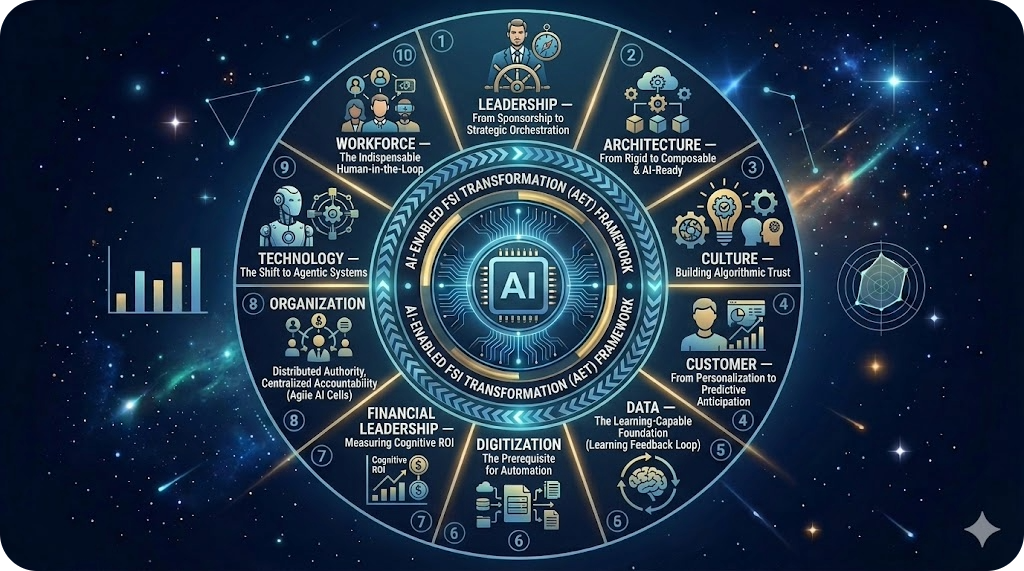
Traditional predictive models are trained once, deployed, and then gradually degrade in accuracy as the underlying data distribution inevitably shifts. To achieve better outcomes and enterprise-scale AI readiness, organizations must embrace Domain 5 of the AI-Enabled FSI Transformation (AET) Framework: Data — The Learning-Capable Foundation.
🔄 The Shift: Data as a Feedback Loop Under the AET Framework, data can no longer be viewed merely as a static “resource”; it must become the Feedback Loop. An AET framework mandates high-quality, real-time data pipelines that allow AI models to retain feedback and adapt to new contexts. Without this rigorous “Data-First” approach, your AI remains a static tool rather than an evolving, appreciating asset.
To build a learning-capable foundation, FSI leaders must focus on three core pillars:
- ⚡ Real-Time Data Streaming: As we shift toward agentic AI systems that make autonomous decisions, batch processing is no longer sufficient. Organizations must implement stream processing, event-driven architectures, and low-latency data access to ensure AI workflows are triggered by real-time events.
- 🛡️ ML-Ready Governance & Explainability: Regulators are increasingly requiring banks to use explainable AI models to prevent biases, forcing institutions to overhaul their data infrastructure. Proper AI governance requires complete data lineage, continuous quality metrics, statistical bias detection, and strict version control to maintain trust and ensure compliance.
- 🔁 Automated Feedback Mechanisms: Organizations must systematically record AI predictions against actual outcomes, continuously monitor performance metrics, and build automated retraining pipelines that update models the moment performance degrades.
🏢 Real-World Success: JPMorgan Chase’s “Living Systems” Industry leaders are already making massive investments to close the Learning Gap. JPMorgan Chase’s $18 billion data infrastructure investment is explicitly focused on creating “living systems” where feedback loops continuously learn, adapt, and improve.
This data-first architecture powered their award-winning LLM Suite, enabling the bank to securely onboard 200,000 users in just eight months. By providing real-time data pipelines and strict data lineage tracking, they are actively positioning their platform as an AI hub capable of supporting autonomous AI agents.
💡 The Bottom Line The distinction between traditional data warehousing and “AI-ready data” is not just technical; it is highly strategic. Organizations that treat data as a dynamic learning loop create AI systems that actually get smarter over time.