

Culture as the Linchpin for U.S. Banks’ Digital Transformation
U.S. banks continue to grapple with the high failure rates of digital transformation (DT) initiatives, risking the loss of both customers and revenue. This shortfall stems from outdated, inflexible legacy systems, insufficient digital innovation strategies, and organizational cultures that resist change. Such challenges are compounded by the rise of agile fintech competitors that easily lure away customers through seamless digital experiences.
- A PYMNTS report revealed that 36% of Gen Z customers preferred fintechs over traditional banks for online payments, reflecting a broader trend of younger consumers gravitating toward personalized and agile financial solutions.
- Millennials and even older demographics, such as baby boomers (67%), showed increasing willingness to switch financial institutions for better offerings
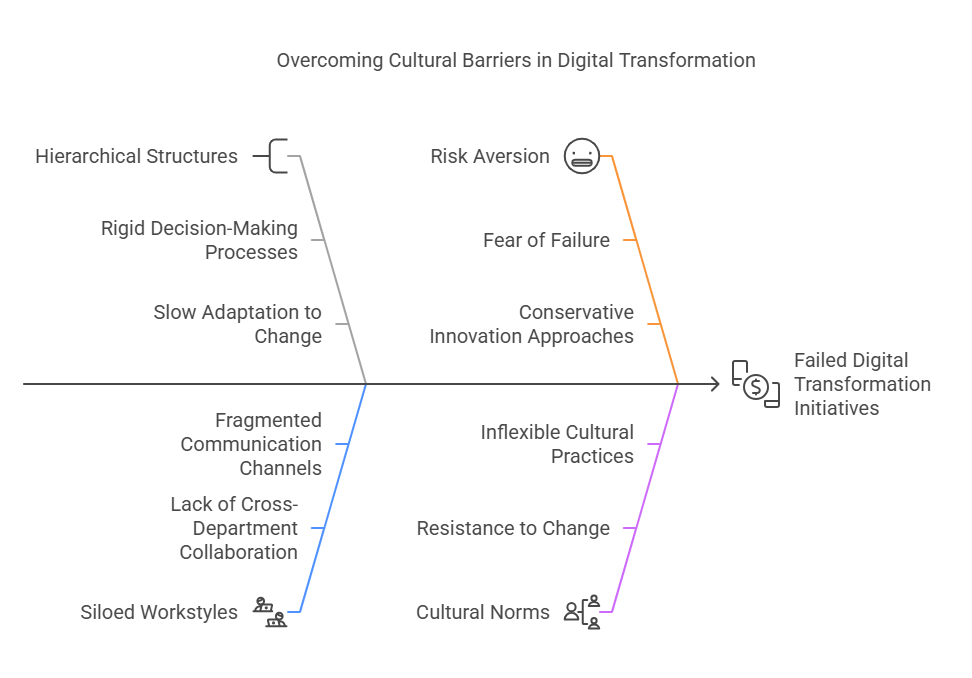
Meanwhile, organizational culture is every bit as crucial as technological proficiency. As the research uncovers, culture often forms the hidden infrastructure that underpins (or undermines) innovation. Traditional hierarchical structures, siloed work styles, and fear of risk limit the agility and responsiveness U.S. banks need to keep pace with external pressures. Without actively reshaping cultural norms, no amount of technical investment can secure successful digital outcomes.
So what can we do about this? Let’s look at how culture can empower U.S. banks’ digital evolution.
Understanding the Core Problem
Ongoing Threats
- Competition from Fintech: Fintech firms leverage modern technologies and nimble operating models, drawing younger and tech-savvy customers away from traditional banking.
- Customer Migration: Customers are increasingly interacting through digital channels. Banks that move too slowly risk losing revenue to competitors offering real-time, customer-centric solutions.
Legacy Hurdles
- Inflexible Systems: A significant obstacle to U.S. banks’ DT efforts is the reliance on COBOL-based mainframes and other aging infrastructures. Migrating core banking systems to the cloud (public or private) remains a daunting but urgent task.
- Cultural Stagnation: A risk-averse environment stifles experimentation, and siloed departments hinder collaboration. Leaders often acknowledge the need for innovation but struggle to convince middle management and frontline teams to adopt new ways of working.
- Legacy Organizational Structures: Often rely on rigid hierarchies, reinforcing siloed processes that hamper collaboration, limit interdisciplinary communication, and undermine knowledge sharing. This environment stifles new ideas, slows decision-making, and erodes team unity, ultimately weakening the organization’s capacity for agile innovation.
- Failure to Communicate with Stakeholders and Users: IT leaders must collaborate regularly with peers across data, data science, and other technology functions to break down silos, streamline processes, and align on strategic goals. Without sustained engagement with the lines of business, IT services risk failing to meet user needs, stifling broader transformation efforts, and undermining organizational success.
Key Research Findings
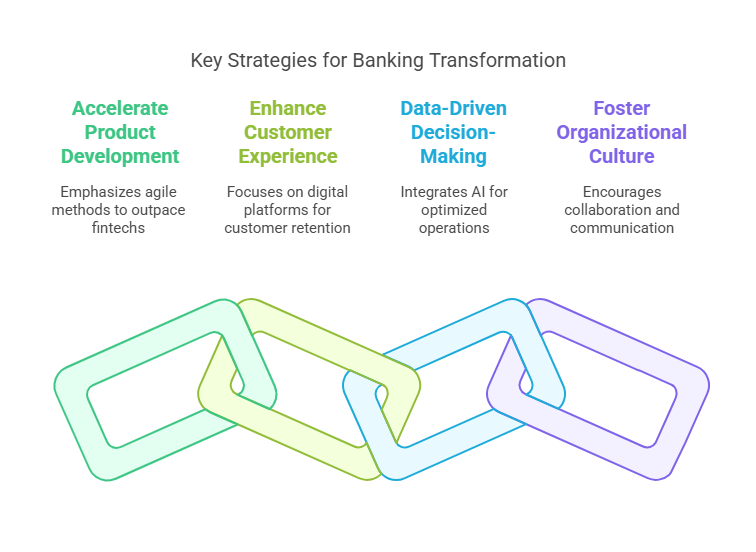
Accelerate Product Development and Delivery
- Leaders emphasized agile methodologies and rapid product rollout to keep pace with fintechs.
- Legacy project-management practices—slow and compliance-heavy—often led to delayed launches and missed market opportunities.
Enhance Customer Experience (CX) and Attract New Customers
- Banks that invest in frictionless digital platforms, personalized services, and robust mobile apps achieve higher customer retention and acquisition.
- An “outside-in” approach—studying consumer needs before developing solutions—consistently delivered better results.
Data-Driven Decision-Making and AI Integration
- Interviewees cited data analytics and artificial intelligence (AI) as catalysts for optimization in operations, improved underwriting, and real-time personalization.
- However, many banks underutilize data because of fragmented architectures, legacy IT systems, and a lack of data literacy training.
Fostering a Collaborative and Communicative Organizational Culture
- Leaders stressed that cross-departmental collaboration was key to handling the complexity of Digital Transformation.
- Transparent communication helped reduce employee resistance, reinforcing buy-in for the transformation journey.
Culture as the Driving (and Sometimes Missing) Ingredient
A unifying conclusion: technology on its own cannot deliver sustained success without cultural readiness.
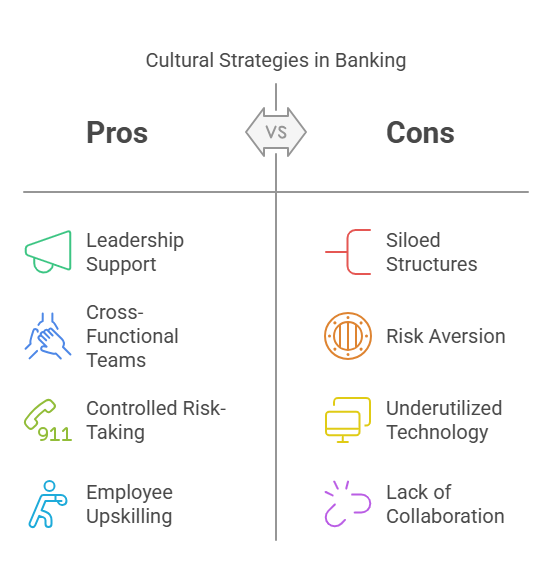
Leadership Buy-In
- Executive leadership must not only “approve” DT but also actively champion it.
- Leaders who model collaborative behaviors—such as regular town halls, open Q&A, and visible sponsorship of pilot programs—increase the employees’ willingness to experiment.
- Leaders who let their team’s ideas come forward and allow their own thinking to be challenged prove to deliver more successful transformation programs with higher value.
Breaking Down Silos
- Siloed structures impede the cross-functional teamwork essential for designing holistic, customer-focused solutions.
- Agile squads and co-located teams proved more effective in rolling out new services than traditionally compartmentalized departments.
Encouraging Controlled Risk-Taking
- Historically, banking has centered on risk avoidance, but rapid digital change demands calculated experimentation. A “safe-to-fail” environment is not optional; it is central to forging an innovation mindset.
- Top-performing banks often fund small pilot projects to test new ideas and then rapidly scale successful concepts.
Upskilling and Empowerment
- People, not systems, drive transformation. Employees at all levels need digital dexterity and soft skills—collaboration, communication, adaptability—to embrace new methods.
- Data analytics and AI remain underutilized unless employees receive training on how to interpret, present, and act on insights.
Recommendations for U.S. Banks
Prioritize Cultural Readiness Alongside Technology
Too often, banks view culture as secondary. In reality, it must be integrated with major technical upgrades. Begin each DT initiative by assessing cultural alignment and addressing gaps in mindset or structure.
Create Agile Delivery Pipelines
Accelerating product development requires rethinking legacy processes. Continuous integration and continuous delivery (CI/CD) pipelines, combined with small, empowered teams, can shorten time-to-market.
Enhance Customer Experience via Data-Driven Insights
Both sets of findings underline the need to systematically leverage data. Develop robust data-governance models and modern data architectures that unify customer data across silos. Research supports and practitionerswarn that siloed data creates mistrust and inefficiency.
Embrace Cross-Functional Collaboration
A digital transformation “center of excellence” or “digital factory” can unite technologists, operations, marketing, and compliance under one roof. Regular cross-functional sessions, open communication channels, and shared performance metrics promote cohesiveness.
Reinforce Leadership Commitment to Upskilling
Train teams on AI, data science, and agile frameworks. More importantly, leadership development programs should focus on how to coach employees through change. Research consistently shows that a well-equipped, collaborative workforce is pivotal for DT success.
The Larger System: Why Individual Leaders Aren’t Solely to Blame
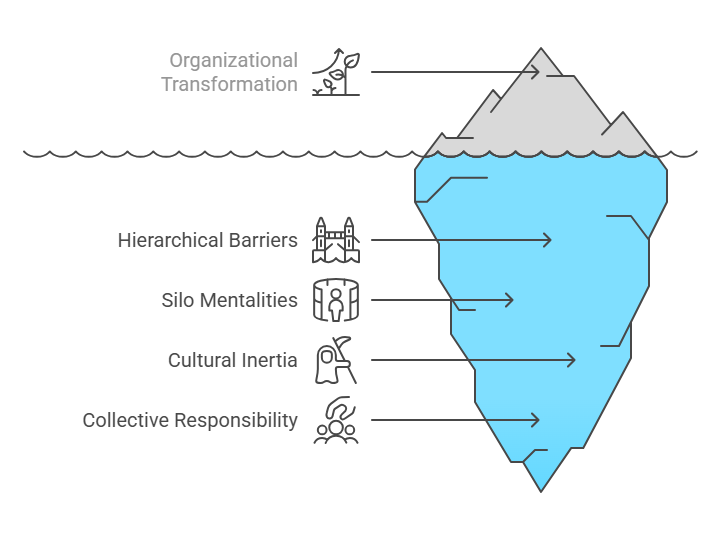
It is tempting to single out individual bank leaders when discussing organizational pitfalls such as rigid hierarchies, siloed work styles, risk aversion, or political turf wars. Yet these challenges often stem from embedded systems, longstanding norms, and legacy processes that no single person initiated—or can fix alone. Leaders inherit structures and cultures that have crystallized over years (sometimes decades) of policies, power dynamics, and stakeholder demands.
Systemic Inertia
Much of what constrains bank transformations originates from historic organizational designs. For instance, rigid hierarchies and siloed work styles are frequently the byproducts of decades-old organizational charts that were once effective for command-and-control management. Over time, these hierarchies deepen, and reporting lines become entrenched. Departments evolve their own vocabularies, procedures, and metrics—further reinforcing disconnection. Although front-line managers and executive sponsors may wish to flatten hierarchies, they face an uphill battle against entrenched practices codified in organizational documents, job descriptions, and performance reviews.
Cultural Reinforcement
Similarly, fear of risk and politics in the enterprise are cultural traits that span multiple leadership tenures. A cautious ethos may have served as a support or protection against regulatory scrutiny, fraud, or credit missteps in banking’s earlier days. Over the years, that focus on compliance and caution can harden into a culture of “do nothing risky,” making it difficult for any single leader to champion the calculated experimentation required for digital transformation. Moreover, political maneuvering often arises from competing departmental goals, incentive misalignments, or unclear power structures. These elements can surpass the influence of one executive or manager.
Colliding Incentives and Competing Priorities
Incentive and reward programs evolve layer by layer over time, usually shaped by HR policies or external compensation benchmarks rather than the input of any one person. They may emphasize profitability, individual sales or goal targets, or certain compliance metrics. When digital transformation demands collective effort like cross-team collaboration or experimental pilot projects, misaligned reward systems can inadvertently penalize employees who invest energy in pursuits that do not directly boost a narrowly defined KPI. And where goals collide, managers or teams can deprioritize strategic innovation projects in favor of short-term metrics needed to secure bonuses.
Collective Responsibility for Change
Because these challenges are systemic and historic, individual leaders can only do so much within the confines of existing structures. To genuinely dismantle hierarchical barriers, reduce silo mentalities, and foster a culture of healthy experimentation, organizations must treat these as enterprise-wide issues rather than blame leaders for problems they never individually created. It requires orchestrated efforts—tweaking policies, changing performance management systems, building trust across functions, and aligning incentives with collaborative objectives. While leaders at all levels play pivotal roles in this shift, the burden for revamping long-standing practices must be shared across the enterprise.
In the end, transformation arises not from the heroics of one executive or visionary manager but from an institution’s collective agreement to revise how it operates. By recognizing the structural and cultural roots of common stumbling blocks, banks can move beyond short-term finger-pointing and begin systematically reshaping the environment in which transformation can thrive.
Conclusion
Digital transformation in U.S. banks is about people as much as (or more than) technology. While modern platforms and AI offer powerful tools, they cannot fix a culture that resists innovation. Breaking down silos, investing in a learning mindset, and enabling collaborative leadership models are foundational to success.
My research and practitioners underscore that accelerating product development, enhancing the customer journey, embracing data and AI, and building a collaborative culture drive revenue and safeguard market relevance. By uniting these insights with a deliberate cultural strategy, U.S. banks can close the gap between legacy inefficiencies and the seamless digital experiences demanded by today’s customers.
In an industry where tech-savvy challengers continue to refine their offerings, banks that embed a forward-thinking culture in every corner of the organization stand to gain a formidable competitive edge. The time is now for U.S. banks to look inward, champion cultural transformation, and empower their people to drive the institution’s next stage of digital evolution.
