⚖️ The Speed vs. Control Dilemma: Why Traditional Hierarchies Are Failing AI ⚖️
In the race to adopt Artificial Intelligence, financial services institutions are slamming into a structural wall. Research reveals a harsh reality: traditional hierarchies are simply too slow for the speed of AI evolution.
Leaders find themselves trapped in a difficult balancing act. Centralized decision-making creates massive bottlenecks that stifle the rapid experimentation needed for AI innovation. On the flip side, allowing fully decentralized, “wild west” AI adoption risks severe inconsistency, duplication of efforts, and catastrophic governance failures.
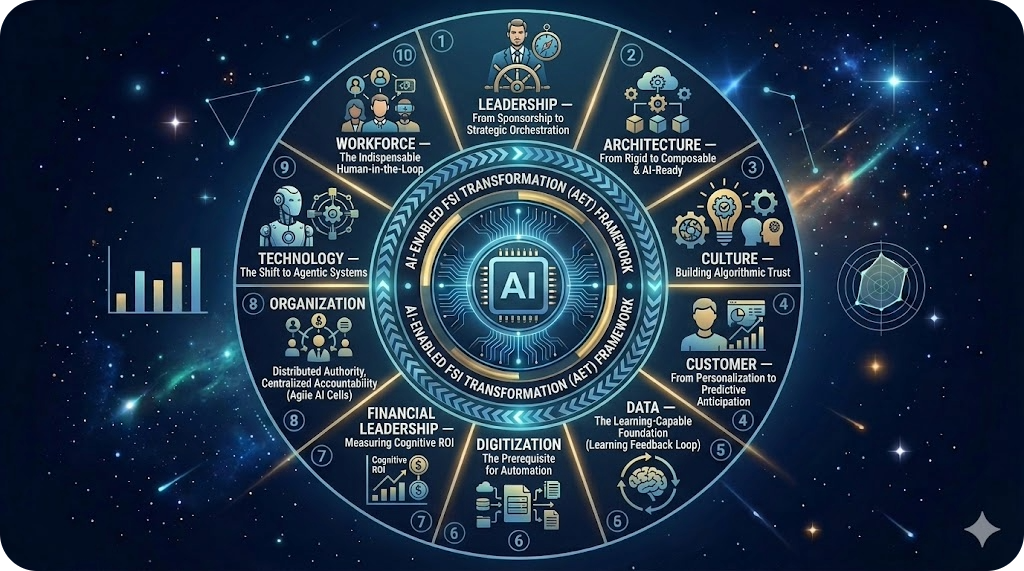
How do we break this deadlock? The answer lies in Domain 8 of the AI-Enabled FSI Transformation (AET) Framework: Organization — Distributed Authority, Centralized Accountability.
🧬 The Shift to “Agile AI Cells” To achieve better outcomes and enterprise-scale AI readiness, organizations must fundamentally restructure how AI teams operate. The AET Framework advocates for the creation of Agile AI Cells.
An Agile AI Cell is a cross-functional unit, bringing together data scientists, engineers, business analysts, and domain experts, that is given the distributed authority and autonomy to rapidly design, build, and test AI solutions. However, this freedom is carefully balanced by centralized governance to ensure strict adherence to ethical AI standards, shared platforms, and security protocols. Teams have the freedom to innovate, but only within clear, centralized guardrails.
🔄 From “Adding AI” to “AI-Enabled” We must stop viewing AI merely as a tool to be bolted onto existing structures. True organizational transformation requires redesigning the enterprise for human-AI synergy. The World Economic Forum emphasizes that this structure requires continuous, real-time monitoring through AI governance platforms to catch risks early, rather than relying on outdated periodic updates.
🏢 Real-World Execution: Bank of America Bank of America provides a textbook example of this organizational model in action. When deploying an internal AI-powered advisory platform to approximately 1,000 financial advisers, they didn’t rely on a slow, top-down rollout.
Instead, they utilized an Agile AI Cell approach:
- Pilot Cell Autonomy: A small team was given the freedom to design and test the platform.
- Centralized Governance: The bank maintained strict AI ethics reviews, compliance oversight, and risk monitoring centrally.
- Distributed Execution: Advisers were empowered to use AI insights within those defined parameters.
The result? Bank of America’s “AI-Powered Meeting Journey” saves financial advisers up to four hours per client meeting. By balancing distributed authority with centralized accountability, they achieved rapid deployment without sacrificing control.
🛡️ Regulatory Validation This organizational design isn’t just a best practice; it is becoming a regulatory expectation. Canada’s Office of the Superintendent of Financial Institutions (OSFI) has introduced the AGILE Framework, which explicitly requires clear accountability, board-level governance, and continuous learning based on AI performance.
💡 The Takeaway The most successful financial institutions aren’t just changing their technology; they are changing their organizational charts. The greatest financial impact comes from institutions that implement structured governance while empowering distributed teams.