🧹 The “Clean Floor” Mandate: Why 60% of AI Pilots Never Leave the Lab 🧹
The financial services industry is rushing to deploy autonomous, agentic AI, yet a staggering 60% of evaluated AI tools never even reach the pilot stage.
Why are so many high-potential AI initiatives failing before they even begin? The culprit is rarely the AI model itself; instead, the failure stems from what researchers call “brittle connections” –> the manual hand-offs, paper trails, and analog components hiding within our daily operations.
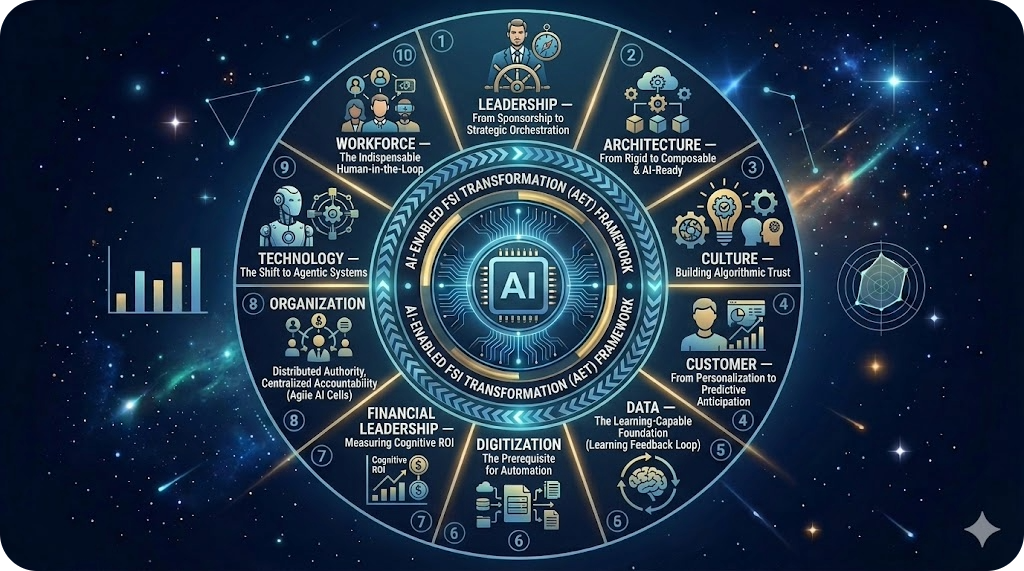
To achieve better outcomes and enterprise-scale AI readiness, we must look to Domain 6 of the AI-Enabled FSI Transformation (AET) Framework: Digitization — The Prerequisite for Automation.
🚶♂️ The “Clean Floor” Requirement A foundational principle of the AET Framework is the “clean floor” requirement: you cannot have Agentic AI (AI that takes action) without full digitization of the underlying process. In short, AI agents cannot operate effectively if they trip over manual, paper-based steps. Until every process step, data input, decision point, and output is fully digital, AI cannot function autonomously.
Complete digitization is a strict prerequisite that requires transformation across multiple layers:
- Customer Interfaces: AI cannot serve customers on paper-based channels.
- Core Processes: AI agents require API-accessible processes, completely free of manual workflow steps.
- Data Capture: AI models require clean, structured data entered right at the source.
- Decision Points & Documentation: Business rules must be codified, and AI needs direct access to digital records rather than relying on gap-filled OCR scans.
🏢 Sequential Strategy: The Citigroup Example Attempting to deploy AI on top of fragmented, partially digitized systems is a trap. Citigroup recognized this and adopted a sequential approach: digitize first, then add AI.
Citi’s CEO, Jane Fraser, prioritized data systems modernization and simplification initiatives. By consolidating data systems, eliminating duplication, and completely digitizing workflows like customer onboarding and compliance, Citi built an API-first architecture. Only after achieving this foundational digitization did the bank successfully launch advanced AI tools like the “Citi AI Assistant”.
⚠️ The Cost of Incomplete Digitization When organizations treat digitization as a parallel workstream rather than a prerequisite, the costs are severe. Attempting to automate partially manual workflows leads to failed pilots, complex integration workarounds, and manual data entry errors that actively corrupt the data used to train AI models. Ultimately, no measurable Return on Investment (ROI) can be realized until the foundational digitization is complete.
💡 The Takeaway Under the AET Framework, digitization is the essential prerequisite for automation. If you want to build the bank of the future, you must first eliminate the manual processes of the past.